

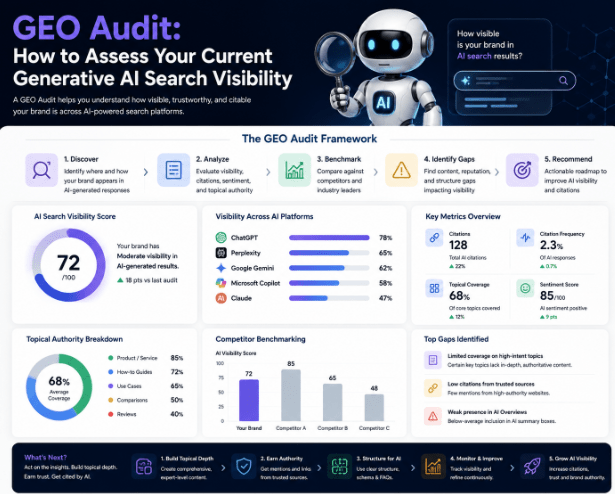
Before you invest in optimizing anything, it’s worth knowing where you actually stand. That sounds obvious — and yet most brands jumping into GEO do so without a clear baseline. They implement changes, produce content, adjust their schema, and then wonder why their AI visibility doesn’t seem to be moving. The problem is usually that they don’t have a clear enough picture of the starting point to know what’s working.
A GEO audit changes that. It’s the process of systematically mapping your current presence — and absence — in AI-generated answers, diagnosing why the gaps exist, and identifying the highest-leverage opportunities for improvement. Done well, it’s the most useful thing you can do before spending a dollar on GEO strategy.
Here’s what a thorough audit actually involves.
Step One: Prompt Landscape Mapping
The first task is defining the territory. What questions are people asking AI tools in your category? These are your target prompts — the queries for which you want to appear in AI-generated answers.
This isn’t the same as your keyword list, though there’s overlap. AI prompts tend to be more conversational and question-oriented: “what’s the best solution for [problem],” “how do companies typically handle [process],” “what should I look for when evaluating [category].” They’re also often more evaluative and comparative than traditional search queries.
Build a comprehensive list of prompts across awareness, consideration, and decision stages. Include brand-specific prompts (queries that mention your company directly), category prompts (queries about your space generally), and competitive prompts (queries that compare you to alternatives). Aim for at least 50-100 prompts to start; more is better for establishing a meaningful baseline.
Step Two: Baseline Citation Tracking
With your prompt list in hand, run each query across the major AI platforms: ChatGPT, Perplexity, Google AI Overviews, Bing Copilot, and any others that are relevant to your audience. Record:
- Whether your brand is cited at all
- The context and framing of any citation (recommended, cautionary, neutral reference)
- Which competitors are cited in responses where you’re not
- The specific content or sources AI systems appear to be drawing from
This is time-intensive to do manually, but it produces invaluable intelligence. GEO services reviews from clients who’ve gone through this process consistently highlight the baseline audit as the moment things clicked — seeing exactly where competitors were appearing in answers where your brand was absent, and tracing back why, is galvanizing in a way that abstract strategy discussions aren’t.
At the end of this step, you should have a clear picture of your current citation rate (what percentage of relevant prompts include your brand) and your citation quality (how you’re framed when you do appear).
Step Three: Entity Health Check
AI systems need to be able to clearly identify and categorize your brand as an entity. The entity health check examines whether the structural signals supporting that identification are strong and consistent.
Key areas to audit:
Schema markup coverage. Does your website have a proper Organization schema? Do your key content pages have appropriate Article, FAQPage, or HowTo schema? Is authorship marked up for key pieces of content?
Cross-platform consistency. Does your brand’s name, description, location, and area of focus match across your website, LinkedIn, Crunchbase, Google Business Profile, Wikipedia (if present), and relevant industry directories? Inconsistencies here are a common hidden cause of poor AI citation rates.
Author entity presence. Do the experts behind your content have established entity presence beyond your own website? Named authors with LinkedIn profiles, publication bylines, and verifiable credentials perform significantly better in AI-attributed citations than anonymous or thinly attributed content.
Structured data errors. Use Google’s Rich Results Test and Schema Markup Validator to identify any implementation errors in your current structured data. Errors in schema are worse than no schema — they can create confusion about what your content actually is.
Step Four: Content Gap Analysis
Given your target prompt list and your baseline citation data, you can now map the content gaps — the topic areas where you have no substantive content to reference, or where your existing content isn’t structured in a way that AI systems can effectively extract and use.
Look for patterns. Are you consistently absent from answers to research-stage questions? You may lack educational content. Are you invisible in comparison queries? You may need honest, well-structured comparison content. Do answers in your category consistently cite a competitor’s published research? That’s a signal you need your own original data.
This analysis becomes the content roadmap for your GEO program. Rather than producing content based on gut feel or keyword volume alone, you’re filling specific gaps identified by actual AI behavior in your category.
Step Five: Competitive Intelligence
The audit should include a parallel analysis of how your key competitors perform in AI-generated answers. Which competitors are most consistently cited? What types of content seem to be driving their citations? What entity signals do they have that you don’t?
GEO optimization services that include competitive intelligence as part of the audit process will typically identify one or two specific content or entity moves that competitors are benefiting from that you could replicate or surpass. This competitive lens often reveals the fastest wins available — not everything your competitors do well, but the specific gaps between their current AI footprint and yours that are most addressable.
Step Six: Technical Crawlability Assessment
A final component of the audit examines whether AI retrieval systems can efficiently access your content. This includes:
- Core Web Vitals and page speed
- Crawl errors and accessibility issues
- Internal linking structure and topical architecture
- Mobile rendering (AI retrieval systems follow mobile-first indexing)
- Robots.txt and noindex configurations that might be inadvertently blocking access to important content
Sometimes the most significant GEO improvement available comes from removing a technical barrier that’s been preventing your best content from being accessed at all.
What a Good Audit Produces
At the end of a thorough GEO audit, you should have:
A quantified baseline — your citation rate, citation quality score, and prompt coverage across key platforms. A diagnosed entity health picture — specific inconsistencies and gaps in your structural signals. A prioritized content roadmap — organized by highest-impact prompt clusters. A competitive positioning map — where you stand relative to key competitors in AI answers. A technical fix list — ordered by estimated impact on AI accessibility.
This isn’t a one-time document. The GEO landscape evolves as AI systems update and improve, as competitors invest in optimization, and as new prompt patterns emerge. Running a full audit annually and a lighter check-in quarterly is a reasonable cadence for most organizations.
You can’t improve what you haven’t measured. A GEO audit is how you move from guessing at what might work to knowing exactly where to focus — and that clarity is worth more than most tactical GEO investments.